1. Describe the decision-making process proposed by Simon.
Simon (1977) described the process as composed of three major phrases: intelligence, design and choice. The intelligence phase is the process which managers examine the situation and indentify and determine the problem. The Design phase involves the validation of the model. This involves assessing the assumptions, sets criteria for choice, lists alternatives and predict and measure outcomes. The choice phase involves the selecting and verification and testing of the solution.
3. Describe the decision matrix.
The decision matrix is the three primary classes of problem structure and the three broad categories of the nature of decisions that are ploted on a grid-matix to form a nine cell desicion support matrix. The type of decision categories are structured, semi structured and unstructured. The three categories of nature of decision are: operational control, management control and strategic planning.
1. What are some of the capabilities of digital dashboards?
-Drill-down ability to go to the details at various levels. This is achieved by examinations through menus and queries.
-critical success factors (CSFs) the factors most critical for the success of business.
-Key performance indicators (KPI) more detail calculations of CSFs
-Status access: the most recent data available on KPI or some other metric in real time.
-Trend analysis: vrious trends of KPIs or metric which are projected using forecasting methods.
Wednesday, October 14, 2009

Week 10 (Chapter 8)
1. What is a Transactional Processing and the role of TP systems. State the key objective of TP/TPSs.
Transactional Processing refers to any business event that generates data that should be recorded and posted in the database.The TP system manage activities such as registering data like transactions, sales, receipts, cash deposits, pay roll credit and etc.
Sunday, September 27, 2009
Week 9 (Chapter 4)
1. What are some of the difficulties in managing data?
In past data was mainly collected in hard paper copy and was filed in cabinets. In modern times data exists in various mediums and texts, such as emails, text, images and audio etc. Keeping a hard copy of these communication data can lead to an overload in terms of space. Even managing data on a system can still create problems and must be managed carefully.
2. What are the various sources for data?
Data can either come from internal or or external sources. Internal data sources is stored internally within an organization. This contain data on the products, people, customers, services, processes, income and expenses. External data sources are made by an independent body which collects general information on a topic.
3. What is a primary key and a secondary key?
The primary key is a unique identifier or code that has no duplicates and can easily recognize an entity. A secondary key are all other fields other than the primary key. Secondary keys can have duplicates and provide information to identify the entity but not with full accuracy.
4. What is an entity and a relationship?
An entity is an individual body (includes person, place, event thing) and is conceived as something separate. A relationship is something that two or more entities have in common.
These relationships are normally displayed on a table showing information on each entity.
5. What are the advantages and disadvantages of relational databases?
Advantages:
-provides information on relationship between individuals
-places information on a single view table
-updates as data on entities change
-easy access to information
Disadvantages:
-only provides certain information
-usually data is not elaborate and simplistic
 http://it.civil.aau.dk/it/education/images_slides/asp_www_db_intro.gif
6. What is knowledge management?
Knowledge refers to what is contextual, relevant and usable. Knowledge normally refers to humans intellects. Knowledge management is about sorting, storing and contextualizing relevant information.
7. What is the difference between tacit knowledge and explicit knowledge?
Tacit knowledge is the knowledge that is difficult to be communicated to another by means of writing it down or verbalized. Explicit knowledge is the exact opposite to tacit knowledge as it is easy to articulate, verbalise and transfer the knowledge using different mediums.
In past data was mainly collected in hard paper copy and was filed in cabinets. In modern times data exists in various mediums and texts, such as emails, text, images and audio etc. Keeping a hard copy of these communication data can lead to an overload in terms of space. Even managing data on a system can still create problems and must be managed carefully.
2. What are the various sources for data?
Data can either come from internal or or external sources. Internal data sources is stored internally within an organization. This contain data on the products, people, customers, services, processes, income and expenses. External data sources are made by an independent body which collects general information on a topic.
3. What is a primary key and a secondary key?
The primary key is a unique identifier or code that has no duplicates and can easily recognize an entity. A secondary key are all other fields other than the primary key. Secondary keys can have duplicates and provide information to identify the entity but not with full accuracy.
4. What is an entity and a relationship?
An entity is an individual body (includes person, place, event thing) and is conceived as something separate. A relationship is something that two or more entities have in common.
These relationships are normally displayed on a table showing information on each entity.
5. What are the advantages and disadvantages of relational databases?
Advantages:
-provides information on relationship between individuals
-places information on a single view table
-updates as data on entities change
-easy access to information
Disadvantages:
-only provides certain information
-usually data is not elaborate and simplistic
 http://it.civil.aau.dk/it/education/images_slides/asp_www_db_intro.gif
6. What is knowledge management?
Knowledge refers to what is contextual, relevant and usable. Knowledge normally refers to humans intellects. Knowledge management is about sorting, storing and contextualizing relevant information.
7. What is the difference between tacit knowledge and explicit knowledge?
Tacit knowledge is the knowledge that is difficult to be communicated to another by means of writing it down or verbalized. Explicit knowledge is the exact opposite to tacit knowledge as it is easy to articulate, verbalise and transfer the knowledge using different mediums.
Week 8 (Chapter 7)
1. Identify common wireless devices and their application to business.
Some common wireless devices include internet connection, cashiers, barcode scanners and printers. Wireless internet connection enables the access to the internet and the business's database from anywere alowing for access to communicationa nd information from on site and out of office areas. Wireless cashiers enable a recording of outbound inventories and inbound sales revenue into the database. This produces efficiency within the business.
2. Describe the various types and general characteristics of wireless transmission media/technologies - microwave, satellite, infrared and radio waves.
Microwave technology is used for mobile phone communication and is a cheap form of transmitting and conecting devices. Satellite is used for lager scale communication and can transfer larger data across areas, this includes must medias . Infrared is used to transfer data over a short distance, previously commonly used by phones but was replaced by bluetooth. Radio waves was used to only transfer audio over a relatively large distance. Currently radio waves can carry internet data using the 3G network and can carry video, text and audio,
3. What is bluetooth/how is it used?
Bluetooth is a wireless communication device typically used for mobile phones. It runs on low energy and connects to a small geographical area. Bluetooth is also used to connect devices such as keyboards, wireless mice and external hardrives to a computer. Bluetooth is typically used for small short ranged devices.
4. What are WLAN's, Wi-Fi, WWAN's, 3G?
WLAN stands for Wireless Local Ares network. Wi-Fi is similar to WLAN but has a diferent protocol, IEEE 802.11. WWAN is the abbreviation of Wireless wide area network, which is a laptop or computer that is connected wirelessly to the internet using mobile-like technology. 3G is the International Mobile Telecommunication. 3G works similar to WWAN except it is specifiacally made for mobile technology.
5. What are the drivers of mobile computing and mobile commerce.
The drivers of mobile computing and mobile commerce is the growing dependence on mobile phones and the ability of collecting information from any location at any time. This flexibility with gathering information has caused an increase in mobile commerce due to the wireless environment and the culture of portable internet.
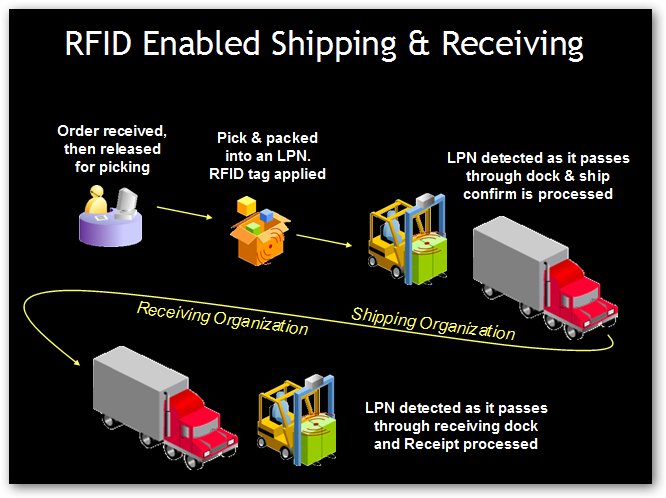
6. Explain the nature of RFID
RFID is the abbreviation of Radio frequency identification. It refers to how objects can be bar-coded and tagged for purpose of tracking and identification. An example is a RFID sticker placed on a retail item in a retail store. This can enable the shop keeper to keep track on the item if it is stolen, in stock or on the shelf.
 http://oracleebusinesssuite.files.wordpress.com/2007/12/rfid-enabled-receiving-and-dispatch.jpg
Some common wireless devices include internet connection, cashiers, barcode scanners and printers. Wireless internet connection enables the access to the internet and the business's database from anywere alowing for access to communicationa nd information from on site and out of office areas. Wireless cashiers enable a recording of outbound inventories and inbound sales revenue into the database. This produces efficiency within the business.
2. Describe the various types and general characteristics of wireless transmission media/technologies - microwave, satellite, infrared and radio waves.
Microwave technology is used for mobile phone communication and is a cheap form of transmitting and conecting devices. Satellite is used for lager scale communication and can transfer larger data across areas, this includes must medias . Infrared is used to transfer data over a short distance, previously commonly used by phones but was replaced by bluetooth. Radio waves was used to only transfer audio over a relatively large distance. Currently radio waves can carry internet data using the 3G network and can carry video, text and audio,
3. What is bluetooth/how is it used?
Bluetooth is a wireless communication device typically used for mobile phones. It runs on low energy and connects to a small geographical area. Bluetooth is also used to connect devices such as keyboards, wireless mice and external hardrives to a computer. Bluetooth is typically used for small short ranged devices.
4. What are WLAN's, Wi-Fi, WWAN's, 3G?
WLAN stands for Wireless Local Ares network. Wi-Fi is similar to WLAN but has a diferent protocol, IEEE 802.11. WWAN is the abbreviation of Wireless wide area network, which is a laptop or computer that is connected wirelessly to the internet using mobile-like technology. 3G is the International Mobile Telecommunication. 3G works similar to WWAN except it is specifiacally made for mobile technology.
5. What are the drivers of mobile computing and mobile commerce.
The drivers of mobile computing and mobile commerce is the growing dependence on mobile phones and the ability of collecting information from any location at any time. This flexibility with gathering information has caused an increase in mobile commerce due to the wireless environment and the culture of portable internet.
6. Explain the nature of RFID
RFID is the abbreviation of Radio frequency identification. It refers to how objects can be bar-coded and tagged for purpose of tracking and identification. An example is a RFID sticker placed on a retail item in a retail store. This can enable the shop keeper to keep track on the item if it is stolen, in stock or on the shelf.
 http://oracleebusinesssuite.files.wordpress.com/2007/12/rfid-enabled-receiving-and-dispatch.jpg
Week 7 (Chapter 5 and 6)
Chapter 5 Questions
1. Describe the underlying technologies, applications and types of Web sites that comprise Web 2.0.
Web 2.0 websites have the capability of a two way conservation. Web 2.0 strives to create: usability, economy, remixability, participation, economy, design and standardization. Web 2.0 enables viewers to have a two way interaction with the website as oppose to its predecessor who only contained information. Below is a picture showing examples of websites that are Web 2.0

http://api.ning.com/files/BiM1Eksyb7S2qBCaLR-kDrfkvL3PrAmueHFI9cyvTDSPwQNlX15vzLHfreaMJg*9RCty2LD-JDAgwrp15A5CHGd4lV-0h80b/web20.jpg
2. Describe the function of Web services.
A Web service is an basically an online software or application that is made to fulfill a specific task. Web services have an embedded code within the webpage to enable it to fulfill its specific task.
3. Describe how you see Social Networking being used in Business.
Social networking can be used within business as a means of communicating with employees and customers. Social networking can enable a more open communication channel between employees of a business to enable them to collaborate and communicate as a team complete a task. It also can enable inputs from other employees from different divisions or locations to provide input, so strategies can have a fuller picture on completing the best outcome. Social networking can also enable customer feedback on products. For example , the Dell company website has online posts from customers expressing their opinions on the product.
Chapter 6 Questions
1. Define e-commerce and distinguish it from e-business
E-commerce is the online transfer of goods and services between producer and seller. E-business, however includes the whole business activity. E-business includes the selling of goods, service, customer help and support transactions and collaborating with business partners.
2. Distinguish among B2C, B2B, C2C and B2E electronic commerce.
B2C refers to business to consumer transactions, while B2B refers to business to business transactions. C2C refers to consumer to consumer transactions typically found with online trading trading websites such as eBay, trading post and carsales.com. B2E is the selling of goods or services from the business to the employees. These transaction are becoming more reliant on internet communications.
3. List some benefits and limitations of e-commerce.
Benefits:
-disintermediation (the removal of the middle retail sellers)
-can market product to a lager scale (national to international)
-lower cost of processing, distributing and retrieving information
-Customers can access and buy products and services at any convenient time
-can deliver a more coherent information on product which will drive product and services to meet the demands of society
Limitations:
-lack of uniformed payment systems
-incompetent telecommunication networks is some areas
-lower socioeconomic areas have less access
-IT problems can drive up running cost of the business
-supply channels have lower quantities creating higher postage prices
- larger markets
-difficulties in marketing to consumers
-higher misinterpreted between customer and business due to lack of dialogue
-perception that e-commerce is insecure and not reliable
1. What are spamming, permission marketing and viral marketing?
Spamming refers to continuous advertising that streams into the system, spamming normally is referred to emails . Permission mark first requires the consent of the individual before regularly informing the individual of new changes to the products. Viral marketing uses social networking sites to create brand awareness or recognition to a general audience.
1. What are micropayments?
Micropayments are payment of small amounts of money . Paypal is an online service that specialize with transactions from the credit card to bank accounts. Micropayments is usually for purchases for online transactions.
2. What is Multichanneling?
Multichanneling is the retailing through more than one channel. This can be through a number of retail outlets and stores and a company website.
1. List some ethical issues in EC.
Some ethical issues surrounding e-commerce is:
-Placing cookies on customers systems
-releasing unauthorized details of a customer to other companies
-not providing secure transaction websites
-not disclosing full information on the product
2. List the major legal issues of EC.
Some major legal issues of e-commerce are:
-no Taxation on products brought overseas
-laws only apply to the country the business and international laws also apply
-The kinds of legal barriers cyberspace has delivered exist primarily in areas of intellectual property, security (including consumer protection), copyright, free speech, gambling, privacy and taxation (McGraw Hill, 2003).(as cited on http://wiki.media-culture.org.au/index.php/E-commerce_-_Overview_-_Legal_Issues)
1. Describe the underlying technologies, applications and types of Web sites that comprise Web 2.0.
Web 2.0 websites have the capability of a two way conservation. Web 2.0 strives to create: usability, economy, remixability, participation, economy, design and standardization. Web 2.0 enables viewers to have a two way interaction with the website as oppose to its predecessor who only contained information. Below is a picture showing examples of websites that are Web 2.0

http://api.ning.com/files/BiM1Eksyb7S2qBCaLR-kDrfkvL3PrAmueHFI9cyvTDSPwQNlX15vzLHfreaMJg*9RCty2LD-JDAgwrp15A5CHGd4lV-0h80b/web20.jpg
2. Describe the function of Web services.
A Web service is an basically an online software or application that is made to fulfill a specific task. Web services have an embedded code within the webpage to enable it to fulfill its specific task.
3. Describe how you see Social Networking being used in Business.
Social networking can be used within business as a means of communicating with employees and customers. Social networking can enable a more open communication channel between employees of a business to enable them to collaborate and communicate as a team complete a task. It also can enable inputs from other employees from different divisions or locations to provide input, so strategies can have a fuller picture on completing the best outcome. Social networking can also enable customer feedback on products. For example , the Dell company website has online posts from customers expressing their opinions on the product.
Chapter 6 Questions
1. Define e-commerce and distinguish it from e-business
E-commerce is the online transfer of goods and services between producer and seller. E-business, however includes the whole business activity. E-business includes the selling of goods, service, customer help and support transactions and collaborating with business partners.
2. Distinguish among B2C, B2B, C2C and B2E electronic commerce.
B2C refers to business to consumer transactions, while B2B refers to business to business transactions. C2C refers to consumer to consumer transactions typically found with online trading trading websites such as eBay, trading post and carsales.com. B2E is the selling of goods or services from the business to the employees. These transaction are becoming more reliant on internet communications.
3. List some benefits and limitations of e-commerce.
Benefits:
-disintermediation (the removal of the middle retail sellers)
-can market product to a lager scale (national to international)
-lower cost of processing, distributing and retrieving information
-Customers can access and buy products and services at any convenient time
-can deliver a more coherent information on product which will drive product and services to meet the demands of society
Limitations:
-lack of uniformed payment systems
-incompetent telecommunication networks is some areas
-lower socioeconomic areas have less access
-IT problems can drive up running cost of the business
-supply channels have lower quantities creating higher postage prices
- larger markets
-difficulties in marketing to consumers
-higher misinterpreted between customer and business due to lack of dialogue
-perception that e-commerce is insecure and not reliable
1. What are spamming, permission marketing and viral marketing?
Spamming refers to continuous advertising that streams into the system, spamming normally is referred to emails . Permission mark first requires the consent of the individual before regularly informing the individual of new changes to the products. Viral marketing uses social networking sites to create brand awareness or recognition to a general audience.
1. What are micropayments?
Micropayments are payment of small amounts of money . Paypal is an online service that specialize with transactions from the credit card to bank accounts. Micropayments is usually for purchases for online transactions.
2. What is Multichanneling?
Multichanneling is the retailing through more than one channel. This can be through a number of retail outlets and stores and a company website.
1. List some ethical issues in EC.
Some ethical issues surrounding e-commerce is:
-Placing cookies on customers systems
-releasing unauthorized details of a customer to other companies
-not providing secure transaction websites
-not disclosing full information on the product
2. List the major legal issues of EC.
Some major legal issues of e-commerce are:
-no Taxation on products brought overseas
-laws only apply to the country the business and international laws also apply
-The kinds of legal barriers cyberspace has delivered exist primarily in areas of intellectual property, security (including consumer protection), copyright, free speech, gambling, privacy and taxation (McGraw Hill, 2003).(as cited on http://wiki.media-culture.org.au/index.php/E-commerce_-_Overview_-_Legal_Issues)
Saturday, September 26, 2009
Week 6 (Tech Guide 4 and 5)
1. Describe the basic telecommunications system?
The telecommunication system is a vast network comprising of both the hardware and software that transmit information from a location to another.
2. Compare and contrast the main wired communications channels ? (Ethernet & Fibre Optic)
Ethernet - The Ethernet cable is a series of wires twisted together to form a cable. The Ethernet protocol is IEEE 802.3. The Ethernet is the most commonly used medium for transporting information.
Fibre Optics - The fibre optics is a series of thin glass fibres that are twisted together to form the Fibre Optic cable. The fibre optic cable uses packets light instead of electic currents as the code of the information. This enables the information to travel faster as the speed of light travels faster then the speed of electric currents.
However, although Fibre Optics cables are much more efficient in speed, it is very expensive, which makes the ethernet the more excepted and most used medium to use.
3. What are the main business reasons for using networks?
The reason for businesses using networks is that it allows more communication channels to open up and allows for more quicker, efficient and precise flow of information and data across the business.
4. What is the difference between LANs and WANs?
The main difference between LANs and WANs is that geographical area they cover. LAN stands for (Local are Network) which encompasses a small geographical area. WAN is the abbreviation of Wide Area Network. WANs cover a much larger geographical area then LANs do and enables a global business to communicate with employees across the globe.
5. What is a network protocol?
The network protocol is a set of rules on how the information is transmitted across the internet using a type of hardware. The most common network protocol is the IEEE 802.3 or ethernet protocol. In this protocol the information travels via twisted wires. The protocol defines how the information travels in packets of electricity through the wires. The protocol demonstrates how the data on both ends of the communication intemperate the information given.
6. Describe TCP/IP protocol.
The TCP/ IP protocol is essentially how the internet works. TCP (Transmission Control Protocol) and the IP (internet protocol) are a set of rules on how devices communicate with one another. Hence creating on what we know as the internet.
The telecommunication system is a vast network comprising of both the hardware and software that transmit information from a location to another.
2. Compare and contrast the main wired communications channels ? (Ethernet & Fibre Optic)
Ethernet - The Ethernet cable is a series of wires twisted together to form a cable. The Ethernet protocol is IEEE 802.3. The Ethernet is the most commonly used medium for transporting information.
Fibre Optics - The fibre optics is a series of thin glass fibres that are twisted together to form the Fibre Optic cable. The fibre optic cable uses packets light instead of electic currents as the code of the information. This enables the information to travel faster as the speed of light travels faster then the speed of electric currents.
However, although Fibre Optics cables are much more efficient in speed, it is very expensive, which makes the ethernet the more excepted and most used medium to use.
3. What are the main business reasons for using networks?
The reason for businesses using networks is that it allows more communication channels to open up and allows for more quicker, efficient and precise flow of information and data across the business.
4. What is the difference between LANs and WANs?
The main difference between LANs and WANs is that geographical area they cover. LAN stands for (Local are Network) which encompasses a small geographical area. WAN is the abbreviation of Wide Area Network. WANs cover a much larger geographical area then LANs do and enables a global business to communicate with employees across the globe.
5. What is a network protocol?
The network protocol is a set of rules on how the information is transmitted across the internet using a type of hardware. The most common network protocol is the IEEE 802.3 or ethernet protocol. In this protocol the information travels via twisted wires. The protocol defines how the information travels in packets of electricity through the wires. The protocol demonstrates how the data on both ends of the communication intemperate the information given.
6. Describe TCP/IP protocol.
The TCP/ IP protocol is essentially how the internet works. TCP (Transmission Control Protocol) and the IP (internet protocol) are a set of rules on how devices communicate with one another. Hence creating on what we know as the internet.
Week 5 (Chapter 3)
1.Provide an IT example that relates to the ethical issues for the ideas of privacy, accuracy, property, and accessibility.
-Privacy: disclosing, collecting and storing personal information that was not permitted by the individual.
-Accuracy: Collecting data that is not directly from the source
-Property: Claiming ownership of a source, information that does not belong to the individual and using an unlicensed software.
-Accessibility: Disclosing trusted information and data to an unauthorized group or entity.
2.What are the 4 general types of IT threats? Provide an example for each one.
1.Natural threats: Bushfire, infrastructure is destroyed.
2.Unintentional threats: Deleting an important file from database.
3.Technical threats: CPU overload and system crash.
4.Malicious threats: Viruses, spam, Trojans and phishing.
3.Describe/discuss three types of software attack and a problem that may result from them.
Viruses are softwares that that inhibit the functioning of the computer. This can be solved by installing an updated anti-virus software and routinely scanning computer for threats. Spam mailing and ad-ware are similar to viruses, that once installed onto the system the program causes continuous streaming of advertisements and pop-ups on the email or when connected to the internet. Trojan horse are a software that can infiltrate a system and can record information from the user and then relays them to another computer.
4.Describe the four major types of security controls in relation to protecting information systems.
1.Backing up data: This involves saving data and information on external sources either on-site or off-site.
2.Training personnel: Training the users about basic precautionary protection of the information system will reduce the amounts of security breaches.
3.Software protection: Installing anti-virus software and having strong password protections for the system can prevent malicious behavior and information theft.
4.Hardware protection: placing the information system in a secure and protected area can reduce theft to the information system.
5.Name one recent software threat and briefly discuss it's effects and resolutions ?
A recent trend in software threats is phishing. Phishing involves sending emails that resemble a bank requesting for personal bank details to be used to hank into an account to gain access to money. Thus phishing is basically a modern example of software theft. To combat phishing could involve installing anti-phishing software but the most effective method is having some basic principles when dealing with accounts on the internet. One way is recognizing the difference between a authentic bank email and a phishing email. Another is never giving bank details over the internet and lastly making sure the banking websites URL is genuine and security coded.
6.What is the difference between authentication and authorization and why are they important to e-Commerce/give an example of their relevance to e-Commerce
Authentication refers to the origin of the source and that it comes form the original person. Authorization refers to the ability of the beholder to change and modify the contents. This is important in e-commerce as verifying that it is the authentical individual that is making a purchase on the internet and that the business itself has the authorization to sell the product. An example of this is an Internet banking transaction. The website must identify the authenticity of the individual and the bank itself must be able to authorize the transfer of funds.
-Privacy: disclosing, collecting and storing personal information that was not permitted by the individual.
-Accuracy: Collecting data that is not directly from the source
-Property: Claiming ownership of a source, information that does not belong to the individual and using an unlicensed software.
-Accessibility: Disclosing trusted information and data to an unauthorized group or entity.
2.What are the 4 general types of IT threats? Provide an example for each one.
1.Natural threats: Bushfire, infrastructure is destroyed.
2.Unintentional threats: Deleting an important file from database.
3.Technical threats: CPU overload and system crash.
4.Malicious threats: Viruses, spam, Trojans and phishing.
3.Describe/discuss three types of software attack and a problem that may result from them.
Viruses are softwares that that inhibit the functioning of the computer. This can be solved by installing an updated anti-virus software and routinely scanning computer for threats. Spam mailing and ad-ware are similar to viruses, that once installed onto the system the program causes continuous streaming of advertisements and pop-ups on the email or when connected to the internet. Trojan horse are a software that can infiltrate a system and can record information from the user and then relays them to another computer.
4.Describe the four major types of security controls in relation to protecting information systems.
1.Backing up data: This involves saving data and information on external sources either on-site or off-site.
2.Training personnel: Training the users about basic precautionary protection of the information system will reduce the amounts of security breaches.
3.Software protection: Installing anti-virus software and having strong password protections for the system can prevent malicious behavior and information theft.
4.Hardware protection: placing the information system in a secure and protected area can reduce theft to the information system.
5.Name one recent software threat and briefly discuss it's effects and resolutions ?
A recent trend in software threats is phishing. Phishing involves sending emails that resemble a bank requesting for personal bank details to be used to hank into an account to gain access to money. Thus phishing is basically a modern example of software theft. To combat phishing could involve installing anti-phishing software but the most effective method is having some basic principles when dealing with accounts on the internet. One way is recognizing the difference between a authentic bank email and a phishing email. Another is never giving bank details over the internet and lastly making sure the banking websites URL is genuine and security coded.
6.What is the difference between authentication and authorization and why are they important to e-Commerce/give an example of their relevance to e-Commerce
Authentication refers to the origin of the source and that it comes form the original person. Authorization refers to the ability of the beholder to change and modify the contents. This is important in e-commerce as verifying that it is the authentical individual that is making a purchase on the internet and that the business itself has the authorization to sell the product. An example of this is an Internet banking transaction. The website must identify the authenticity of the individual and the bank itself must be able to authorize the transfer of funds.
Subscribe to:
Posts (Atom)